Whether you love it or loathe it, there’s no doubt that AI-generated content is everywhere right now. Individuals, community groups and even established brands are using it to create everything from festive campaigns to product imagery and social content.
And it’s easy to see the appeal, seemingly offering the promise of polished creative quickly, cheaply and with less effort involved in its creation. For marketing teams with stretched budgets and limited capacity, it seems like the perfect solution.
Let us be clear, as a creative agency, we’re not anti-AI, we’re just careful to make sure we’re using it only where it adds genuine value. AI is baked into the software tools we use every day and it’s incredibly useful for certain tasks like extending backgrounds and generating meeting notes. It streamlines some more mundane tasks which frees us up to apply our distinctly human skills to better effect for our clients. But as questions circle around authenticity, quality, trust and the impact on human creativity (and the planet), we can’t simply ignore its pitfalls.
For purpose-led brands and charities, these questions are particularly important. If your organisation exists to make a positive difference to people and the planet, does using AI-generated design sit comfortably with your values?
And yes, generating creative design completely using AI could save your organisation a few pounds in the short term, but could it end up costing your brand much more in the long run?
Authenticity matters, especially to purpose-led brands
For charities and purpose-led organisations, your authentic mission and values are absolutely key to your brand, and your audiences expect your communications to reflect those values.
Using AI-generated content without considering its environmental impact, the people whose creative work it may draw upon, or the potential effect on audience trust can create a disconnect between what an organisation says and what it does.
This doesn't mean every use of AI is automatically at odds with a purpose-led brand. It means organisations need to make conscious, informed choices about when it’s appropriate to use it.
Example:
A nonprofit community sewing centre is just one example of an organisation that’s been forced to issue an apology after receiving a backlash from its followers for using an AI generated image to promote their organisation.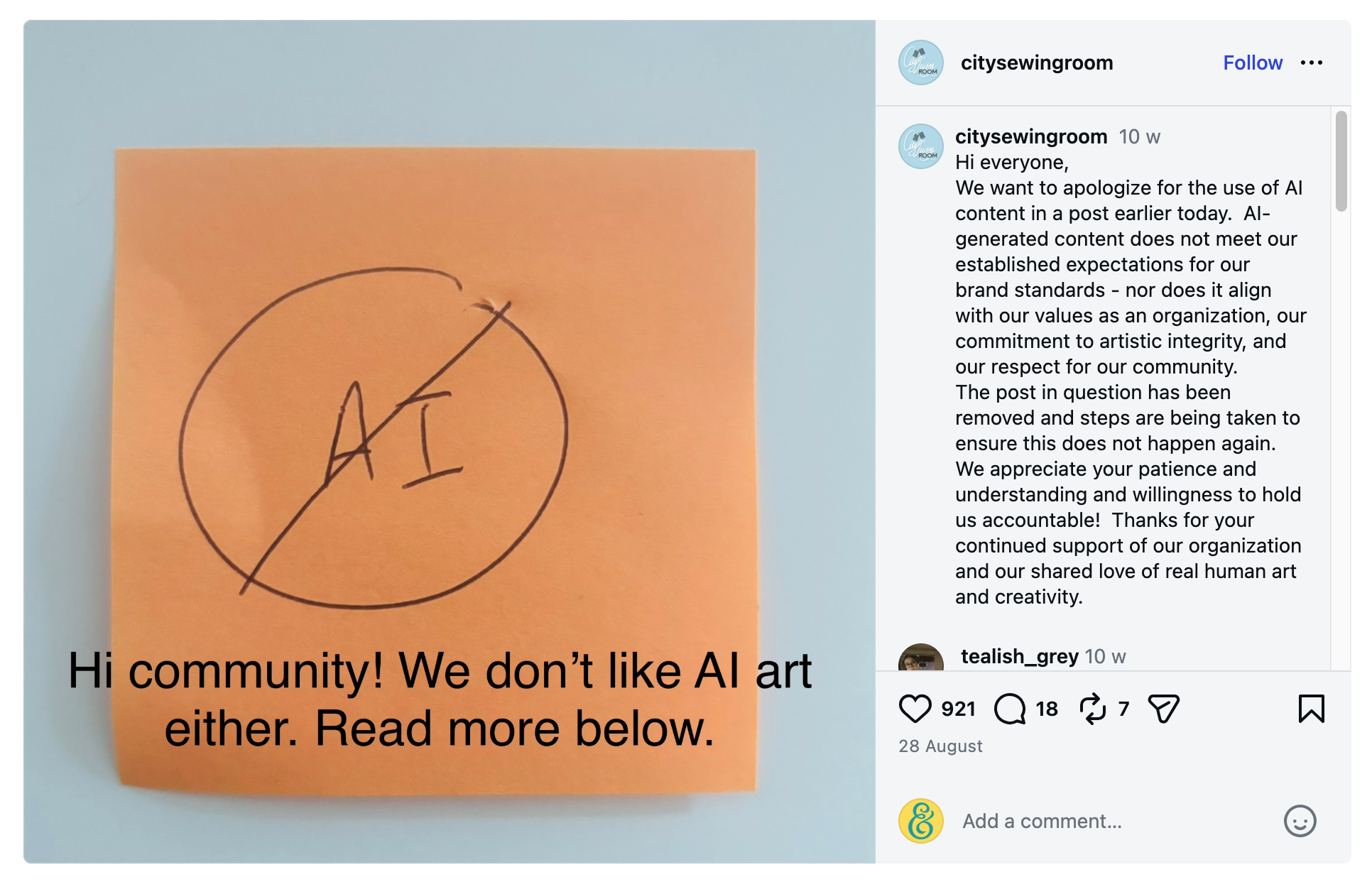
Questions to ponder:
Does this approach genuinely support our values, our audience and our objectives? Or are we using AI simply because it's convenient?
How brands build trust
Trust is absolutely vital for charities and non-profits but AI is creating a real issue in this area. The 2026 Brand Experience Report from PAN found that 66% of consumers experience "AI credibility fatigue," and 43% say they no longer trust much of anything online.
Your brand identity should be carefully developed to make your organisation recognisable and distinctive. It includes your colours, typography, logo, imagery, tone of voice and the way everything works together.
AI-generated content can struggle to reproduce these elements accurately and consistently. The result may look disconnected from your established identity, weakening brand recognition over time.
If your communications don't look, feel or sound like your brand, you risk confusing your audience and eroding the trust you've worked hard to build.
Your creative assets should be distinctively yours. Often AI generated imagery has its own look which means your content could just blend in with content made by other organisations using the same tools. You also have less control over details in AI generated visuals which could result in imagery that misleads your audience.
Example:
When we created the new identity for the Kent County Show, we collaborated closely with the client to ensure that the bespoke illustrations accurately reflected the show's exhibits and attractions. This gave the campaign a distinctive visual identity rooted in the real experience visitors could expect. It also provided the scope to adapt and build on the identity meaning the creative could be used over a number years instead of starting from scratch for each year’s event.
Questions to ponder:
Is our organisation’s visual brand identity consistent and visible? If I removed our logo, would I still know it was our content? Does the content accurately represent our offer?
Accessibility shouldn't be an afterthought
Effective design isn't just about looking good. It needs to communicate clearly and work for the people you're trying to reach.
AI-generated visuals often have problems with composition, contrast and visual hierarchy. Text within images may be either gobbledygook or distorted, making it hard to read.
Overly busy imagery, confusing layouts and a lack of clear focal points can make communications harder to understand and engage with. And if people without visual disabilities find it hard to decipher, imagine what a screen-reader would make of it.
If your brand and communications don’t comply with accessibility standards, you could be creating unnecessary barriers for 20% of the population who have a disability.
Accessibility should be considered from the outset, rather than treated as something to fix afterwards. A human creative team can make informed decisions about how people will interact with content, taking account of different needs and making sure the message is clear and accessible to everyone.
Example:
Whenever we create a brand identity, we ensure your fonts and colours meet web accessibility standards. We can also create a set of bespoke social media templates and set them up in Canva or Adobe Express to help your team take the guesswork out of creating content.
Questions to ponder:
Does everything on the AI-generated graphic make sense? Does the most important information stand out? What elements could we do without?
Is it good quality? Does it add real value?
Your creative content should look like you’ve made an effort. If you’re expecting your audience to engage with it, you should engage with it before it goes out. If it looks or sounds like it’s straight off the ChatGPT press, or it looks cheap and generic, it could devalue your brand in the eyes of your audience.
52% of readers reduce their engagement when they identify AI-generated content, according to a 2025 theStacc report, while a large share of Gen Z, Millennials, and Gen X report unfollowing, muting, or blocking creators and brands whose posts feel like AI slop.
Sprout Social found that 66% of consumers are becoming more selective about what they consume on social media. Perhaps organisations should likewise become more selective with what they put out.
Example:
You might’ve been able to use AI to generate a single graphic that looks alright, but what happens when you need to print it large-scale or use it for a banner that’s a different size or shape? A designer will create high quality graphics with flexibility built in, considering how elements can adapt across formats while looking part of the same creative.
Questions to ponder:
Are we becoming reliant on AI to keep up with an unrealistic posting schedule? Would investing more into fewer high quality pieces of content provide more value to our audience?
Why your brand is worth investing in
We understand the financial pressures charities and purpose-led organisations are facing right now. Budgets are tight, teams are stretched and every investment needs to demonstrate value.
But cutting corners on creative isn't necessarily the most cost-effective solution. Investing in good design isn't simply about making things look better. A strong, consistent and distinctive brand can help your organisation stand out, build recognition and strengthen connections with your audiences, all of which can help to drive real business growth.
Take live-in care provider Consultus as an example. In the year after their brand refresh, they gained 15% more managed care clients, bringing in a massive £1.02 million in additional revenue per year (approx). They were also recognised as one of the top 50 fastest-growing businesses in Kent and Medway in the MegaGrowth 50 (2026).
Example:
Within the month after the launch of their rebrand, community dining charity FoodCycle saw a 1,000% increase in web searches for ‘community dining.’ They also saw improved performance for their annual volunteer recruitment ads and a 5% increase in conversion rate, reducing cost per sign up from £2 to £1.62. Their social media engagement increased by 5%, as did their donation page conversion rates.
Questions to ponder:
Is our brand still working for us or is it holding back our growth? Are we communicating our purpose effectively?
Final thoughts
AI tools are revolutionising the way we work, and individuals and organisations alike are understandably excited to explore ways to embed these new tools into their workflows.
Some of these tools can be genuinely useful, but technology should support better creative work, not become a substitute for it. Organisations, especially those designed to create some kind of social or environmental benefit, should use human judgement when using AI to generate visual creative assets.
For purpose-led organisations especially, authenticity, authority and accessibility should be at the heart of every creative decision.
Audiences are likely to lose trust in, or disengage completely from your organisation if the creative that you put out is of poor quality or doesn’t align with your brand and the values they associate with you.
We help purpose-driven organisations translate lived experience into authentic brands and creative communication that drives real-world impact.
We bring the strategic brain, empathetic heart, and determined muscle to create emotive, human-first branding to help you connect with your audiences, inspire action and deliver impact that genuinely matters.
Disclaimer: This blog was written with a little assistance from AI and a massive helping of human creativity.
If you enjoyed this blog post, why not subscribe to our Linkedin newsletter Behind me&you, your monthly round-up of insight and inspiration for purpose-driven brands and charities.
To discuss how we can help your organisation take your brand or communications to the next level, book a free chat with Matt.